
We think we are something and that we are someone.
We carry a name, a story, a set of achievements — and we call that our “self.” We cling to identities ( e,g VP of marketing or something). We think we are successful or unsuccessful, kind or angry, spiritual or worldly.
Yet, all of what you think about yourself is false.
Every label, every belief, every idea of who you are in your own head — is merely a reflection in a cracked mirror. To see the truth, one must shatter the mirror that they have created for themselves. If you do not shatter it yourself, time will do that job one day for you.
There is a story from the Mahabharata that reveals this illusion beautifully — the conversation between Arjuna and Shiva.
Don’t Think Too much about Yourself Son, You are a Nobody – Shiva to Arjuna
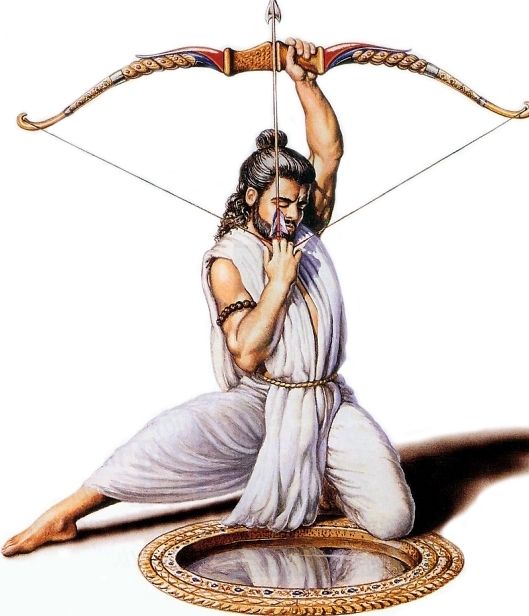
After years of penance and preparation, Arjuna set out to acquire the Pashupatastra — the most powerful divine weapon, guarded by Lord Shiva himself. His heart burned not only with the vow to defend dharma but with wounds that had not healed: the memory of the Lakshagriha, where the Kauravas tried to burn his family alive; the rigged game of dice that stripped the Pandavas of kingdom and honor; and the courtroom where his beloved wife, Draupadi was dragged and nearly disrobed while elders looked away.
His heart burned with the desire to be the greatest warrior, to defend dharma, to fulfill his destiny. But beneath those noble intentions lay something subtler — the pride of being “Arjuna” – the mighty archer, the invincible hero of the Pandavas.
For how could he not feel invincible? Krishna himself kept affirming, time and again, that Arjuna was the finest archer alive. On the other side, Bhishma and Drona proclaimed to the world that any army with Arjuna at its center could not be defeated — that Arjuna alone was equal to all of them combined. And Arjuna had already given history its proof in the Virata war: standing all alone, he broke the Kaurava ranks, humbled their greatest warriors, and returned victorious.
Kripacharya had said the below to Karna when the latter said he can tackle Arjuna alone
Karna, you are nothing but a deluded fool, drowning in the ocean of your own ego in your pursuit to defeat Arjuna. You will never fulfill this vain ambition. Yes, you are a skilled archer and a formidable warrior — but remember, a fish is very skilled in swimming but it cannot cross the vast ocean by swimming alone. Know your limits, Karna, and pick your battles. Restrain your false pride (ahankar). For Arjuna is not merely a warrior — he is a volcano, and if you challenge him, you will melt in his flame before blinking an eye.
Praise from friend and foes alike became a mirror that convinced him his reflection was the truth.
The Incident Between Arjuna and Shiva – how Arjuna was taught a lesson in Humility
One day, as Arjuna was deep in meditation, a wild boar charged towards him. Instinctively, he drew his bow and shot an arrow, piercing the beast.
At that very moment, another arrow struck the boar. From the forest’s edge, a rugged hunter stepped out, his body smeared with ash, a bow slung across his shoulder, and his eyes glowing with quiet fire.
The hunter claimed the kill was his. Arjuna, proud and irritated, confronted him. Words turned into a duel.
Hunter: That was my prey, warrior. My arrow struck it first.
Arjuna: Your prey? Look again, hunter. My arrow pierced the boar’s heart before yours even touched it. Do not claim what is not yours. Take your arrow and leave.
Hunter: (smirking) You may be a fine archer among kings, but in this forest, arrows and pride both travel slower than truth. The arrow is mine and the kill as well.
Arjuna: Mind your words, o hunter. Do you know who you are speaking with? I am Arjuna.
Hunter: Arjuna? Who is this Arjuna? I do not know any Arjuna, what are you talking about?
Arjuna: I am Arjuna, the finest of Archers that has ever lived. For your information, I am Kunti Putra “Arjuna”— disciple of Drona, wielder of Gandiva, the slayer of mighty warriors.
Hunter: Drona? Who is this Drona? I don’t know any Drona or any Arjuna.
Arjuna: When Arjuna’s arrows rain on the enemy, it spreads fire. This Fire destroys warriors just like sun destroys dry grass through its heat. Beware o foolish man, you don’t know you are inviting your death.
Hunter: Ahh the pride. Pride comes before a fall, young man. Don’t think too much about yourself. You are a nobody.
Arjuna: You are insulting me hunter, I am telling you one last time, step back. You do not stand any chance to fight with the mighty Arjuna, who has been trained in warfare by the famous sage Drona. If you have any love for your life, step back and go to your family.
Hunter: Have you inherited this ego because of your Guru? Have you inherited this ego because you are an archer? Have you inherited this ego because you belong to some royal family?
If this ego is for your guru, I salute him. But please note that there is no glory in getting born in a royal family or just because you have mastery of a specific skillset. What is the real reason that you consider yourself so valuable? What is the source of this false glory that you have attached to your soul? For your information, I don’t care of any Arjuna or Drona and I am going to take the kill with me. If you wish to prove your claim, then try to stop me if you can.
Anger rushed through Arjuna, his grip tightened on the Gandiva. He fired a volley of arrows towards the mere hunter, determined to kill him and avenge the insult.
The hunter did not flinch. He lifted his bow and met every shot calmly. Arjuna’s arrows snapped in the air. Some were split. Some were brushed aside and none reaching their mark.
Arjuna shot high, he shot low, he circled to the left and then to the right. It made no difference. The hunter stood as steady as a rock, moving only when he needed to, always one step ahead of the “invincible” Arjuna.
The forest watched in silence.Arjuna’s breath grew heavy, sweat ran down his back, his legs trembling in disbelief. With each miss, pride cut deeper than any wound. How could a common hunter break the arrows of Arjuna? How could a stranger stand against his Gandiva?
Something in him gave way. The anger cooled. The noise inside his head went still. Breathing hard, his pride wounded – Arjuna finally dropped his bow and approached the hunter.
Arjuna: Only 4 has the merit to beat Arjuna. Bheesma, Drona, Indra and Shiva. Who are you, hunter? You are not Bheesma, neither Drona. You must be Shiva. No mortal could have withstood my arrows.
The hunter’s smile deepened. His form shimmered — the ash on his body glowed like molten gold, the bow in his hand blazed with divine light.
Hunter: Arjuna, the warrior who thought himself invincible. You fought not for truth, but for your pride. You sought to conquer others, yet could not conquer yourself.
The Hunter then revealed his real identity, with a Trishul in one hand and Pashupatashtra in another, it was Lord Shiva himself.
Shiva: Rise, son. You are now ready to receive what you sought. The weapon was never denied to you—it awaited your surrender first. I came to humble you and crush your ahaṅkara (ego). A warrior, however mighty, must never think too highly of themselves. Life will place before you many battles, many wars, many opponents—but know that the subtlest enemy is your own pride. Do not mistake borrowed strength for your own. Before the Infinite, you are no one.
This universe itself is but a flicker; I could end it in the blink of an eye. When I see mortals drowning in ego and false pride, I walk among them—now as a beggar, now as a lawkeeper, now as a punisher—so they may remember what they truly are: dust illumined by grace.
Learn this well. Think less of yourself and more of Truth. The Pashupatastra is now yours; you will need it against Bhishma, Drona, Karna, and Ashwatthama. But behold o Arjuna – this weapon is never to be fired on a weaker opponent or on ordinary foot soldiers. Use this only in situations of extreme need. And check your ego in the battle-field.
Remember – before the eternal, you are a nobody.
With that, Shiva placed his hand upon Arjuna’s head, granting him the Pashupatastra — not as a mark of conquest, but as a symbol of humility and awakening.
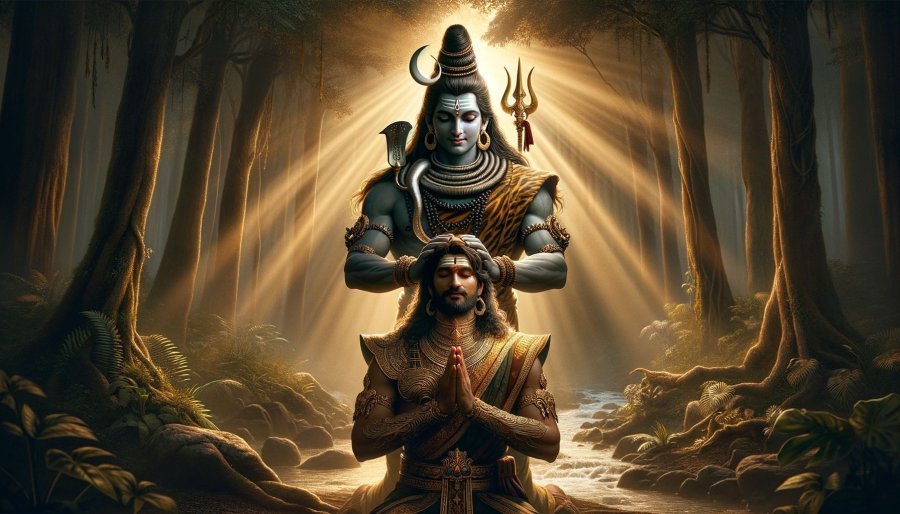
The next time someone humbles you—at your desk, in the boardroom, or before an audience—remember: that is Shiva at work.
He is reminding you to curb the ahaṅkara, to let pride fall away so you can rise clearer and steadier. Take the correction, not as humiliation, but as initiation—so you become a better warrior, ready to face the battles with humility and resolve.