
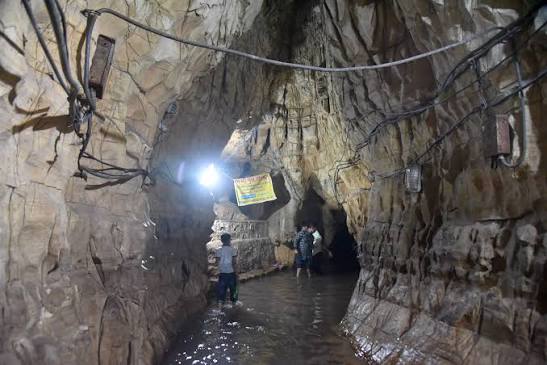
Hidden among the wooded hills of Chitrakoot in Madhya Pradesh lies Gupt Godavari, one of the region’s most revered pilgrimage sites. The shrine consists of two ancient limestone caves through which a narrow stream of crystal-clear water flows year-round.
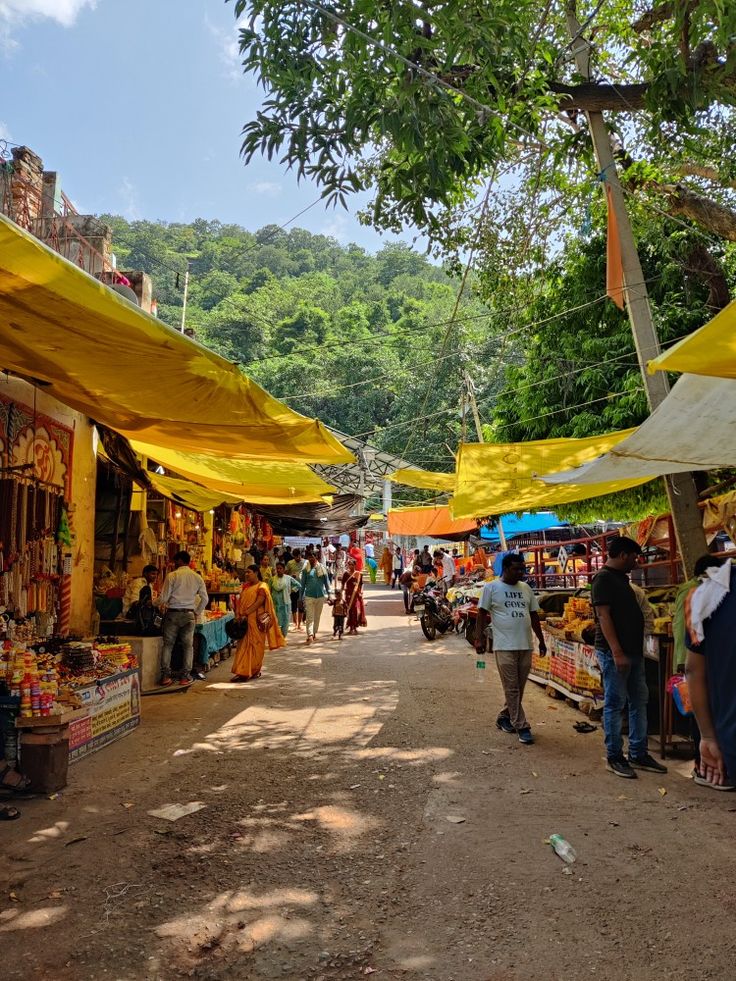
According to Hindu tradition, Lord Rama and Lakshmana are believed to have held court here during their exile, making the caves a place of deep religious significance. Every day, thousands of pilgrims walk the narrow path leading to the caves, passing rows of small shops selling flowers, incense, coconuts, and offerings for worship.
Like most Indian pilgrimage centres, the entrance is alive with movement. Pilgrims, wandering ascetics, shopkeepers, children, and beggars all become part of the same timeless landscape. For most visitors, the journey ends with a visit to the sacred caves.
For me, however, the real pilgrimage began only after I stepped outside.
It was there, sitting quietly among a row of beggars just before the entrance to the caves, that I noticed an old man whose appearance seemed to repel everyone around him. He looked like a madman, or perhaps a forgotten wanderer who had been living on the roadside for years.
Yet something about him refused to let me walk away.
What followed was one of the most remarkable conversations I have ever had with a wandering monk – a dialogue that challenged many of my assumptions about spirituality, temples, desire, renunciation, grace, and the nature of God itself.
A short distance before the entrance to the Gupt Godavari Cave, where small shops line both sides of the path, there is a spot where beggars usually gather to ask passing pilgrims for alms. Seated there, slightly apart from the others, was an old man.
To call him a holy man would be misleading. At first glance, he looked more like a madman. In fact, he possessed every outward sign that people typically associate with insanity. That was certainly my first impression.
His appearance suggested that he had not bathed in years. A life spent sitting and sleeping amid dust and dirt had left its mark on his body. He was bare chested, his skin coated with thick layers of grime that had hardened over time, resembling the rough bark of an old tree. It seemed as though a mere scrape of a fingernail would cause the dirt to flake away in patches.
His face was covered with a coarse, uneven beard. His long hair was tangled and matted, hanging in complete disarray. The only clothing he wore was a tattered strip of cloth that reached almost to his knees. It looked less like a garment and more like an old, oil stained rag discarded after years of use.
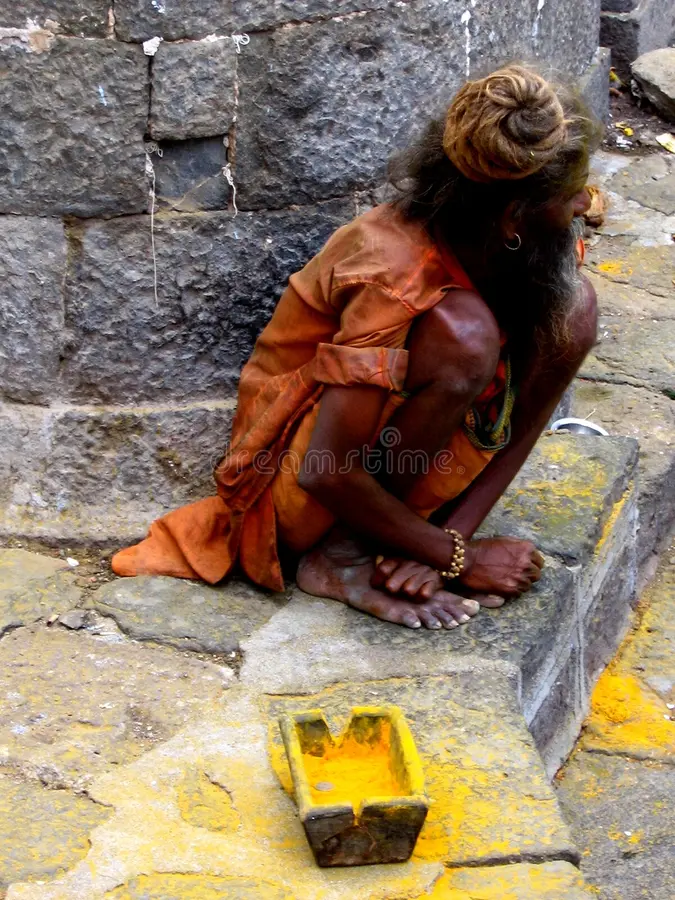
Image for depiction only, not the original picture of the sadhu
He owned nothing. There was no begging bowl, no water pot, no blanket, not even the few possessions that wandering ascetics usually keep with them.
Pilgrims walked past him in an endless stream. Occasionally, he would raise his head and quietly look into someone’s face. A moment later, he would lower his gaze again. He never stretched out a hand for alms, nor did he call out to anyone. He simply sat there, entirely self-contained, as though the bustle around him had nothing to do with him.
Yet, despite sitting among the beggars, there was something unmistakably different about him.
He stood apart without making the slightest effort to do so. It was the kind of distinction that is instantly recognizable – just as a woman raised in a cultured and respectable household can often be identified, even when she is surrounded by many others.
As I was walking back from the Gupt Godavari Cave, my eyes were drawn to him almost by accident. I stopped beside a roadside shop and watched him from a distance. After a few moments, curiosity got the better of me, and I moved closer.
It was then that I noticed his eyes.
They were unlike the eyes of a madman or of any ordinary person, for that matter. They possessed an extraordinary depth, luminous and serene, with an almost divine quality that is difficult to describe.
In that instant, I found myself unable to judge his age.
After a while, it became clear that he was aware of my steady gaze. He looked up and met my eyes for a brief moment. The glance was enough to tell me that my silent scrutiny had made him uncomfortable. I decided to wait and see what would happen, so I stayed exactly where I was.
Ten minutes slipped by.
His uneasiness became increasingly evident.
I, however, remained rooted to the spot, unwilling to move even a single step.
Then I noticed that he was muttering something under his breath. Every now and then, he would glance in my direction.
Now I looked carefully into his eyes. They were extraordinarily large and wide. Much of them was partly hidden behind the strands of hair that had fallen across his forehead. It seemed as though light was radiating from them. They were calm, yet unwavering. I noticed another unusual feature – his eyelids barely moved. A long time would pass before he blinked even once.
I remained standing there, motionless, for nearly half an hour.
Suddenly, he got to his feet and began to walk.
I followed him, keeping a short distance between us. After we had walked some way, he turned around once to look behind him. He saw that I was still following. He immediately quickened his pace.
I increased my speed as well.
After covering a little more distance, he looked back again. I was still there.
Soon we reached an open stretch where there was no one around. The old man slowed his pace. I quickened mine slightly so that I could come closer.
Within moments, we were walking side by side.
Before I could say a single word, he spoke in a sharp, almost harsh voice…
“Why are you following me?”
he demanded abruptly in Hindi.
His voice was sharp, but I answered as gently as I could.
“I noticed that you became uncomfortable when you saw me. Then you suddenly got up and walked away. I simply followed.”
Until that moment, a small part of me had still wondered whether he might truly be insane. But the instant he spoke, my doubts were cleared. My first impression, formed the moment I looked into his extraordinary eyes, had been right. This was no madman. He had to be a saint of a very high order. How else could one explain those luminous, unwavering eyes or the strange way they seemed to remain open for so long without blinking.
His expression hardened.
“Enough. Now leave.”
I smiled inwardly. If I had intended to leave, I would never have followed him this far.
So I said politely,
“Come, Baba. Let’s sit somewhere for a while.”
“What do you want from me? Why should I sit with you? Go! Leave me alone. Stop following me.”
I paid no attention to what he said. I knew that answering him sharply would ruin everything. So, in an even more humble voice, I asked,
“Have I done you any harm?”
The intensity in his voice did not diminish in the slightest. In the same tone and manner of speaking, he replied,
“You haven’t done anything. But stop following me.”
He said nothing more. Slowly, he began walking again, and I walked behind him. After we had gone some distance, he suddenly stopped. Fixing me with a fierce stare, he said,
“So, you really won’t stop following me? Is that it?”
I remained silent.
The force of his gaze sent a shiver through my body. For a moment, I thought I should give up and let him go wherever he wished.
Then another thought crossed my mind. Perhaps he was a highly accomplished saint. Perhaps he had already understood what was in my mind. I had so many questions I wanted to ask, but he clearly had no desire to answer them. That was why he was trying to get away from me.
I would not give up.Keeping my head bowed, I continued to stand there.
Now visibly agitated, he shouted,
“You son of a bitch! Are you still not going to stop following me?”
Without saying a word, I suddenly bent down and touched his feet in reverence. I did it so quickly that the holy man had no chance either to stop me or to say anything.
The gesture had an immediate effect. It was as though water had been poured onto a fire. He calmed down at once. Even his expression changed completely.
He walked a little farther and sat down beneath a tree by the side of the road. I sat down beside him.
People continued to pass by. Many looked at us as they walked past.For several minutes, neither of us spoke.
At last, the holy man broke the silence.
“Tell me, what is it? What do you want with me?”
Keeping my head bowed, I replied,
“Baba, when I first saw your outward appearance, I thought you were either a madman or a beggar. But after looking into your eyes, I felt that you must be a highly accomplished spiritual practitioner. That is why I followed you…”
He did not let me finish.
In an irritated voice, he interrupted,
“Quiet! Never say such things again. A spiritual practitioner? Hah!”
Leaving that subject aside, I asked,
“How many years have you been living at this holy place?”
He answered immediately,
“Why do you want to know?”
His question took me back to my school days.
There had been countless mornings when I arrived at school without having done my homework. The teacher would ask me to recite the lesson, and I would stand there in silence, my head bowed.
To anyone watching, I must have looked overcome with shame.
The truth, however, was rather less noble. I felt neither embarrassed nor guilty. Children who are habitual shirkers soon learn that lowering their heads often ends an uncomfortable conversation more quickly than offering excuses.
So I borrowed the same childhood tactic.
“It’s nothing important,” I said quietly. “You could simply call it curiosity.”
The answer had barely left my lips before he dismissed it.
“You have no need to know such things,” he said. “You may go now.”
Despite every attempt, I had made no real progress with him. Still, I refused to become impatient. By now I understood that every direct question only provoked another evasive answer. If this conversation was ever going to happen, it would have to begin on his terms, not mine.
There was a packet of bidis in my pocket. For a moment, I considered offering him one, but I lacked the courage. In the end, I decided that silence was my best companion.
So I simply sat and waited.He, meanwhile, watched me with quiet attention.
Nearly twenty minutes passed.
Then, at last, he spoke.
“Son,” he asked gently, “where are you from?”
The change in his voice caught me completely by surprise. Only moments earlier it had been harsh and cutting. Now it overflowed with such warmth and compassion that it scarcely seemed possible for the same man to be speaking. Unless one heard it firsthand, one could hardly believe a human voice could sound so tender.
My heart leapt with relief.
Overcome with gratitude, I bowed once more and touched his feet. The instant I did, something happened that I have never forgotten.
A rich fragrance of sandalwood began to rise from his body, filling the air around us. The scent lingered on my hands long after I had touched his feet.
Looking up, I said,
“I come from Kolkata. I have been travelling across the country, seeking both pilgrimage and the company of saints. The moment I saw you, I felt you were no ordinary man. That is why I could not bring myself to stop following you.”
Hearing my words, the holy man’s face broke into a smile. His entire expression seemed to change.
He asked,
“So, you’ve travelled a great deal?”
I nodded and replied, “Yes.”
He remained silent for about a minute. As though reflecting on something, he gently shook his head before saying,
“I’ve been here for a very long time. How long exactly—I couldn’t tell you.”
I asked,
“Baba, why do you live in such a filthy condition? Is it to conceal your true identity?”
Pilgrims continued to pass by, along with a few villagers. Glancing absent-mindedly in their direction, he replied,
“My son, only those who possess something feel the need to hide it. I have nothing to hide.”
Then he continued,
“Do you know why I live like this? Sugar left neglected in a warehouse doesn’t attract ants. It’s the carefully stored sugar that draws them. That’s why.”
I realized that now, if I asked questions, I would receive answers.
So I asked,
“Baba, why is there so much resentment, so much sorrow, so much suffering among human beings? Is there no way for people to be free from all this? Can they not attain even a little peace?”
The holy man looked at my face after hearing the question. Without pausing even for a moment, he replied,
“My son, the world moves according to its own laws and in its own rhythm. But insignificant human beings try to make this vast world conform to their own ideas, their own rules, and their own wishes. As a result, they encounter constant obstacles and disappointments along the way. Resentment and sorrow therefore become inevitable. That is why ordinary people find neither freedom from suffering nor lasting peace.”
I immediately asked,
“But those like you… those who have renounced the world… you are human too. Why does this not happen to you?”
The holy man answered simply,
“Those who have abandoned worldly life or even those who remain in it, yet move with the natural order of the world – go through life without resistance. Their lives are filled with joy because they have no conflict. They have never tried to possess the world as their own. But even after taking this path, if someone, out of ignorance, begins to claim the world as his own, he too becomes like everyone else. He cannot free himself from worldly resentment, sorrow, and suffering.”
Then he gave an example.
“Suppose someone renounces the world and becomes an ascetic. After some years, a new thought enters his mind: ‘I will establish an ashram. People will respect me. I will gain followers.’ The moment such thoughts arise, he has already stepped outside the natural order. Once he begins living against that order, his happiness is destroyed, and so is his peace.
“Tell me, my son—if no one accepts you, what have you really lost? And if everyone accepts you, what have you really gained? Are you going to take any of that with you when you leave this world?”
I asked,
“But, Baba, you have spoken about ascetics. What about those who live in the world? They need to establish themselves in life. They also have worldly responsibilities and needs.”
He nodded in agreement and replied,
“Of course they do. But the needs of householders never come to an end. No one knows where those needs finally stop. Even the person who has those needs does not know how much is truly necessary.”
“To live in this world, everything has its place and its necessity. But there are also differences in how much of each thing is actually needed. The moment there is an imbalance between one’s desires and the natural order of the world – whether over possessions, circumstances, or even thoughts – restlessness, resentment, and sorrow arise. It is difficult to free oneself from them.”
“Those who have succeeded in becoming free… those who are able to do so… are very few indeed.”
For a moment, I reflected on the strange nature of the holy man. Only a short while earlier, he had been trying to drive me away like a stray dog from the roadside, refusing to speak to me at all. And now… the change in him was remarkable.
Suddenly, he asked,
“Tell me, you said you’ve travelled to many places. That’s good. I suppose you visit temples, have darshan of the deities, and offer worship like everyone else?”
The abrupt change of subject caught me by surprise.
I replied, “Whenever I visit a pilgrimage site, I naturally go to the temple, just as everyone does. As for offering worship, that’s different. If I feel like it, I do; if I don’t, I don’t. But why do you ask?”
His face grew serious.
Looking steadily into my eyes, he said,
“If you truly seek inner growth, if you desire spiritual well-being, then stop going to temples.”
“Listen carefully. Temples naturally attract countless people, especially the famous ones. When you enter such places, they do not promote spiritual welfare – in fact, they do more harm than good. Of course, if spiritual growth is not what you seek, then that’s another matter.”
His words startled me.
“Baba,” I said in astonishment, “I’ve never heard anyone say such a thing.”
He replied gravely,
“Yes, my son. What I’ve said is true. The moment you enter a crowded temple, worldly desires cling to the mind like an octopus. Even if you pray to God for liberation, they cling to you. Even if you deliberately think of nothing, they still cling.”
Try the experiment yourself. Visit a temple where large crowds gather. Stand or sit inside for a while. Don’t deliberately think about anything. Then come outside and stand quietly somewhere. You’ll notice that all kinds of desire filled thoughts begin to arise in your mind.
“This happens to everyone. But only a careful observer notices it. Most people never pay attention.”
Having said this, he paused.
He picked up a fallen leaf from the ground, held it by its stem, and slowly twirled it between two fingers as though absent-mindedly tickling his ear.
Still turning the leaf, he continued-
“Or this may happen: you may enter a temple free from worldly desires and stand there for a while. Gradually, without realizing it, your state of mind will change. Thoughts filled with worldly desires will begin to arise one after another. The longer you remain there, the more such thoughts will occupy your mind.”
I listened in complete astonishment.
I had never heard anything like this before. I tried to remember whether I had ever experienced such thoughts after visiting a temple. My mind became confused.
The holy man went on,
“But if you visit a temple that stands in solitude, where hardly anyone comes, worldly desires will not suddenly arise in your mind. Your mental state will remain distinct. Such secluded temples are far more beneficial than those famous ‘awakened’ temples that attract crowds.”
However, if someone seeks the fulfillment of worldly desires, those famous temples are indeed effective.
But if a person truly wishes to become free from desire and keep the mind established in supreme bliss, then it is better not to enter any temple at all.
Tell me, what will happen merely by pouring a pot of water over the head of Vishwanath? Will that alone earn you merit? Will it grant you liberation? If it did, then everyone would have been liberated by now.”
Unable to contain my curiosity, I asked,
“Baba, you said that when a person enters a temple, worldly desires begin to cling to the mind. Why does that happen? How does it happen? What is the reason?
The holy man remained silent for about a minute. There was no change in his expression. Nor did he appear to be searching for an answer. His eyes slowly swept across the surroundings before he finally spoke.
“It is the very word temple that exerts a hold over people. It attracts them from distant places. They come carrying countless desires. Inside the temple, prayers are constantly offered for the fulfillment of those desires. As a result, the atmosphere within the temple becomes permeated with worldly longings.
The spoken words of those prayers, together with the waves of thought behind them, become embedded in the walls of the temple and continue to circulate within its enclosed atmosphere.
The moment someone enters the temple, those countless thoughts and spoken desires, floating in the atmosphere, attach themselves to the person’s body and mind. Then they begin to work upon him. The mind gradually fills with desires. All of this happens invisibly and without one’s awareness. It cannot be seen with the eyes. Only those whose body and mind have become purified can perceive it.
Remember this: no spoken word and no thought ever completely disappears. They remain. They continue to float in the atmosphere and become impressed upon objects enclosed within a place.”
Having said this, the holy man began to explain with an example.
He continued,
When a husband and wife lie beside each other for some time, the sexual thoughts of one begin to affect the body and mind of the other, arousing them. No matter how firmly they resolve to remain detached, they will not be able to for long. A day or two, perhaps but eventually the same thing happens. It is the same with temples. Those influences will affect you – they certainly will.
When the body and mind become purified, you will understand the nature of temples for yourself. Such purification comes through remembering God, contemplating him, and deep meditation.
Those who have attained that purity can sense when a person burdened by desires comes near them. The thought-waves of such a person touch their body and mind. That is why they often become uncomfortable and prefer not to keep such company.
But remember one thing with certainty: unless a person possesses genuine spiritual power born of practice, entering a temple will inevitably fill the mind with desires.
If you truly seek the growth of the mind, then do not enter the temple. Have the darshan of the deity from outside. The liberation of the mind is never found inside a temple.
I was astonished by what I had heard.
India is the land of spirituality and penance. Countless pilgrimage sites and innumerable temples are scattered across the country. Could all of them really be filled with worldly desires? Do those who visit them receive no spiritual benefit at all? I had never come across such an idea in the life of any saint I had read.
I decided not to dwell on it just then. There were too many other questions I wanted to ask, and I did not wish to lose the opportunity.
Changing the subject, I asked,
“Baba, to which spiritual tradition do you belong?”
I was still surrounded by the rich fragrance of sandalwood. Even my own body seemed filled with its scent.
At the mention of the word “sampradaya” (spiritual sect), the holy man laughed.
“So, after all your education, this is the understanding you’ve gained?” he said. “Those who live in the kingdom of God, those who call upon Him – do they belong to any sect? Does one have to join a sect in order to call upon God?”
After hearing this, I had nothing more to say on the subject.
So I asked something else.
“Baba, at what age did you leave home? And why did you leave?”
For a moment, he seemed slightly uncomfortable. Almost immediately he recovered himself and replied,
“Whatever the Supreme Self willed that alone happened. Those matters are of no concern to you.”
Still, I pressed him gently.
“Please tell me, Baba. There must have been some reason. Why did you leave?”
He remained thoughtful for five or seven minutes before answering.
“My son, just as no one becomes a saint or a scientist merely by trying, neither does anyone become a thief simply by trying. Every path is already destined. Mine was this.
Of course, there were worldly reasons as well. But I have left that life behind. Since it has been left behind, there is no point speaking about it.”
I understood that he had no wish to return to his past.But whether he wished to or not, I wanted to know.
Holding his feet, I pleaded,
“Please tell me, Baba. There is no harm in speaking of it.”
As he gently moved my hands away from his feet, he said,
“Enough, enough. Let go of my feet. Such things are not meant to be spoken of by monks.”
I released his feet.
He remained silent for a while. The expression in his eyes and on his face changed completely. It seemed as though he had travelled back into a distant past – a place no monk willingly returns to.
“My son, I cannot say exactly how old I was then. Perhaps seven, eight, or nine.
As soon as I was old enough to understand anything, I saw my father brutally beating my mother. Whether there was a reason or not, I never knew. There was hardly a single day when my mother was not beaten by him.
I could not bear to see her suffer like that. Even after my father left for work, my mother would sit alone and cry. I would bury my face against her chest and cry with her. I felt nothing but anger toward my father.
But I was only a child. I could do nothing. I could not stop him, nor could I even speak against him.
As soon as he finished speaking, his eyes filled with tears.
I could no longer look at his face.An uneasy feeling rose within me.
After waiting for a moment, I said,
“Baba, you are a monk. You have no worldly ties. Your life is beyond worldly happiness and sorrow. Yet you are crying? Does that mean you still carry the same attachment that ordinary householders do?”
At once, tears began rolling down his cheeks.
His voice trembling, he replied…
“My son, does becoming a monk mean that I am no longer allowed to weep? I can shed tears for God, but not for my sorrowful mother? Tell me, who is closer to a child than his mother? No one. Nor can anyone ever take her place. And you speak of attachment?
I have no worldly attachment, my son. If I did, would I have been able to leave my mother behind and renounce the world?”
There are two kinds of attachment: worldly and spiritual. Worldly attachment creates bondage. Spiritual attachment gives rise to renunciation.
Even God has attachment. It is because of that that He suffers for His devotees.
Imagine a devotee in great distress. He knows nothing but God. Yet because of the law of karma, even God must remain outwardly detached while the devotee undergoes suffering. The pain God feels for His devotee – that too is a form of attachment. But it is spiritual, not worldly. It is God’s loving concern for His devotee.
It is through that divine attachment that renunciation awakens within the devotee. God’s gaze remains fixed upon him. And because of that, God continually follows after His devotee, seeking to grant him liberation.”
My son, every word I have spoken is true. People do not believe such things because they cannot be seen with ordinary eyes.”
The more I listened, the more astonished I became.
He remained silent for a while. When I gently reminded him of the earlier part of his story, he continued,
“Every day I watched my mother being abused like that. I had no power to protest. Gradually, a deep sense of disgust began to grow within me.
One day, my father beat her mercilessly. It was the kind of beating no one should ever have to witness. My mother lost consciousness and collapsed to the floor.
I could bear it no longer. I ran out of the house.That was the end of it. I never returned.”
Hearing how he had left home filled me with unease.
It occurred to me that had tears for his mother never found a place in this monk’s life, perhaps his renunciation itself would have been incomplete.
Neither of us spoke.About ten minutes passed in silence.
Finally, I asked,
“Baba, how old would your father be now?”
A shadow crossed his face.
After thinking for a moment, he replied,
“I left home a very long time ago, when I was only a child. I can’t say for certain.”
He fell silent again.
After several minutes of thought, he added,
“I would guess… perhaps eighty or eighty-five.”
I asked quietly,
“Baba, where was your home? And after you left, where did you go?”
He wiped the last traces of tears from his eyes with both hands before answering.
“When I walked away from home, there was no peace left in my heart. My mother was all I could think about. I wept for her day and night.”
In those days, my tears were my only companion. I cried so much that eventually it felt as though I had no tears left. They simply stopped coming.”
There was no one to whom I could speak. And even if there had been, what could I have said? Inside my chest I carried a pain I could neither describe nor escape.
My mind was in turmoil. I had no regular place to sleep, no certainty of food, no routine, no direction. I survived by begging. Whatever came into my hands, I ate. And so I drifted from place to place, living one uncertain day after another.
My home was in Saharanpur.”
He stopped speaking.A long, heavy sigh escaped him. Then he looked quietly into my face, as if measuring whether I was truly listening.
I said nothing. After a moment, he continued.
“After many hardships, I eventually reached Vrindavan.
The image of my mother’s face never left me. Every waking moment I saw her as I had last seen her – helpless and suffering. The memory tormented me. Nearly eight months passed like that. One day I was sitting alone on the banks of the Yamuna at Gaughat, once again lost in thoughts of my mother.”
His eyes brightened slightly, as though recalling a turning point.
“Suddenly, I saw a sannyasi with long matted locks standing directly before me. I didn’t hesitate for even a moment. The agony within me had become unbearable. My broken heart was no longer under my control.
I threw myself at his feet, clasping them tightly, and began to weep uncontrollably. I could not utter a single word. Nor would I let go of his feet.
He gently lifted me up. Then he embraced me and said,
“Come, my son. I have come for you. Why do you grieve? I am here.”
He paused for a while, looked up towards the sky and then continues
There was nothing more to be said. I became the sannyasi’s companion.
He gave me a loincloth. I discarded my old, torn, filthy clothes and put it on. We left Vrindavan for Haridwar. From there, we travelled on foot to Rudranath. In those days, the route was extremely difficult and remote. It was nothing like today, when so many people travel there.
After staying at Rudranath for a few days, the sannyasi initiated me into the spiritual path. He became my revered Guru. The initiation took place at the Rudranath Temple.
From the very moment of initiation, all the pain within me disappeared. My mind found steadiness. At last, I knew peace.
I was astonished by the holy man’s story.
What an extraordinary transformation! What an unimaginable meeting! Could there really be any explanation for such a thing?
Still absorbed in wonder, I asked,
“Baba, in those days the path was extremely difficult. Some pilgrims travelled to Kedarnath and Badrinath, but hardly anyone went to Rudranath. Even if a few did, they were very few. How did you find food there? And where did you stay?”
I noticed that the uneasiness which had shadowed his face earlier had now completely disappeared.
He replied…
“There were many caves there. One of them belonged to my Guru. He had been living there and practicing austerities long before I arrived. I learned all this much later. I stayed with him in that very cave. Just the two of us. I spent nearly seventy long years in the Himalayas, in that mountain cave at Rudranath.”
I asked,
“Baba, how old was your Guru?”
He frowned slightly. It seemed he could not arrive at an answer.
“My son, I cannot say exactly how old my Guru was. I never asked him such questions the way you are asking me. When I first met him, he was already very old. Yet strangely, he never seemed old. The skin on his body had become thick and deeply wrinkled with age.
I remained with him for nearly seventy years. As for food, my Guru would always bring whatever we needed. I never had to worry about such things.”
I asked him the same question again.
The cave was deep in the lonely Himalayas. In those days, very few pilgrims came that way. There were hardly any people from whom alms could be obtained. There were no nearby settlements where food could easily be found.
How, then, did they manage to obtain food every day?
For the first time in quite a while, a faint smile appeared on the holy man’s face.
“I cannot tell you where my Guru obtained our food from,” he said. “But every day he would bring delicious fruits, fine ghee, flour, vegetables – whatever was needed. Whatever we felt like eating, he would bring. Not once did we go hungry.”
My curiosity only grew stronger.
I had to discover the secret of how food was found in such an inaccessible part of the Himalayas. What he was saying seemed almost unbelievable.
Unable to contain myself, I asked,
“But Baba, where did your Guru bring all this food from every day? Who gave it to him?”
The holy man answered without the slightest change in expression,
I was never as curious as you are. My Guru had given me shelter. At that time, that alone was enough for me. So I never asked such questions.
It seemed to me that the holy man was trying to avoid the subject. So I approached it from another angle.
Baba, there was no one living in that lonely place from whom alms could be sought. Yet your Guru somehow brought food every day. After spending so many years with him, surely you must have some idea of where it came from or how he obtained it.
At this, the holy man finally spoke.
My Guru was a yogi. His yogic powers were extraordinary. He obtained all our food with the greatest ease. Never once did I see him beg for alms. Never once did I see him stretch out his hand before anyone.
My curiosity knew no bounds.
Did you ever witness any of those extraordinary powers with your own eyes?
His face lit up.
Witness them? Why, I spent nearly my entire life watching my Guru’s astonishing abilities. I never even realized how the years passed. I could go on telling such stories forever.
Since you asked about food, let me tell you a small incident.
One morning it began to snow. Then came the rain. What rain it was! I had never seen such a downpour before. Fierce winds accompanied it. There was no sign that it would stop. As the day wore on, it became impossible even to step outside the cave.
We had no firewood and no food left. My Guru already knew that, but I mentioned it anyway.
He smiled and said, ‘Don’t be afraid, my son.'”
Still seated inside the cave, he slowly stretched one arm outside. It kept growing longer and longer. I watched in amazement until it passed beyond the reach of my sight.
A moment later, he drew it back to its normal length. In his hand were a bundle of dry firewood, flour, vegetables, and ghee – despite the heavy rain and snowfall.
No one today would believe such a story.Perhaps you won’t either.
After saying this, he paused for about a minute.
Then he continued,
“My son, there was one thing I always noticed. My Guru never brought more than what was needed. Nor did he ever store anything. Whatever was required on a given day, he brought exactly that much. There was never even a single extra piece of bread.”
I could make no sense of what he had told me. For some time, I sat overwhelmed with wonder.
Then I asked,
“Surely you have travelled to all the sacred places across India?”
He shook his head.
No, my son. I have visited Kedarnath, Badrinath, Yamunotri, Gangotri, and Gomukh. I have never gone anywhere else. The Himalayas are a land of spiritual practice. Waves of bliss are always flowing there. Can such joy be found at any other pilgrimage? That is why I never left the Himalayas. My mind never wished to.
I asked,
Then why did you leave the Himalayas and come down to this crowded place of pilgrimage?”
Until then, his eyes had remained fixed on me. Now he looked away for a moment, glancing around before turning back to me.
“After my Guru left his body, I thought I would come once more to the world of people. It had been many years since I had done so, and so I came. Then I shall return to that cave where my life of spiritual practice began.”
After saying this, I noticed that an air of quiet melancholy settled over him. It seemed to me that he had returned, in his mind, to that life in the cave.
I asked,
But you will return there one day. Your Guru is no longer there. In such solitude, how will you find food? Will you obtain it the way your Guru did?”
He burst into laughter. There was something otherworldly about that laughter.
Still smiling, as though avoiding a direct answer, he said,
“My Guru will provide.”
Then I asked,
“Baba, we often say that God exists, that He is kind to us, that we live by His grace, that His blessings are upon us. But aren’t these just words? We don’t really understand what they mean, do we?”
His face glowed with joy as he replied,
My son, whenever something good happens in a person’s life that lies beyond ordinary human planning or expectation, the joy that naturally arises within—that is God’s grace, that is His compassion.
Why should it be difficult to understand?
Every person can recognize it by reflecting on his own life. For some, it appears in small ways; for others, in great ways. That is the only difference. But it happens almost every day.
And yet people never pause to notice it. They never try to feel the unseen grace and compassion that God continually showers upon them.
The truth is, no one is more ungrateful than human beings.”
I began thinking about what he had said.
The holy man looked at me and asked,
What is it, my son? What are you thinking about so deeply? Is there ever any end to thinking? The more you think, the more your thoughts will entangle you.
I realized there was little to be gained by dwelling on it.
So I asked,
A little while ago you said that when a husband and wife lie beside one another, the desires of one influence the body and mind of the other. But you never lived a householder’s life. You spent your entire life in the Himalayas. How did you come to know this without ever living beside a woman?
The holy man answered without the slightest hesitation.
My son, that belongs to the mystery of creation itself. When true knowledge awakens within a person, such things become known naturally. No one needs to teach them.
Still unable to resist my curiosity, I asked,
“Tell me honestly, Baba – have you yourself ever been affected by desire?”
Far from being offended, he laughed.
“My son, no living being is entirely beyond the influence of desire. But let me speak about my own life.
I went to the Himalayas with my Guru when I was just a little boy. At that age, I understood nothing of such matters. Then the greater part of my life passed in the cold solitude of a Himalayan cave. Apart from spiritual practice, I had no other occupation.
While living there, I saw the face of a woman only rarely – perhaps once or twice in an entire year. There was simply no need for me to leave the cave and go among people.
I saw only my Guru. I saw only the ever-changing beauty of nature.
In the first years of youth, desire stirred my body a little, but it never disturbed my mind. Through rigorous spiritual practice, self-restraint, celibacy, and above all my Guru’s grace, desire never gained control over my mind – not once, not even for a single moment.”
Something about his answer left me unconvinced. Before I could stop myself, I said –
Baba, you told me that desire stirred your body a little but never your mind. Is that really possible? Every action has its origin in thought. If there is no thought of desire in the mind, how can the body respond to it? How can there be physical signs of desire when there is no desire in the mind?
Before I had even finished speaking, he replied, as though he had anticipated my question.
My son, in my youth, desire existed in me in the same way that it exists in the body of a small child.
A young boy’s mind is untouched by thoughts of desire. Yet if you observe carefully, you will sometimes notice physical signs of sexual arousal while he is asleep or even awake. Those signs do not arise from thoughts of desire.
They occur according to the natural laws of the body.
That was how desire existed in me. The physical signs appeared because of the body’s vital seed, but my mind remained untouched. There was no mental reaction—none then, none ever.
I then asked,
In your opinion, Baba, which life is better—a householder’s life or the life of a monk?
He reflected for a moment before answering with a smile…
He smiled and replied,
A person who has found success and fulfillment in every aspect of worldly life can hardly imagine the hardships of a monk’s life. To such a person, the householder’s life will naturally seem better.
On the other hand, someone who has failed in worldly life may think that the life of a monk is full of happiness and freedom, untouched by worldly troubles.
But, my son, I have seen many monks who, after spending years on this path, could not bear its hardships and severe discipline. They eventually returned to worldly life.
So it is difficult to say which is better.
I pressed him a little further.
Even so, Baba, what do you think? Which life is better?
He answered without emotion,
Look, my son, a householder may possess everything, yet lack peace. A person without peace has nothing, even if he seems to have everything. In that sense, no one in the world truly possesses anything.
A monk may possess nothing else, but he has peace.
Worldly life is good. But if one must live in the world, then one should live in it together with the Supreme Self. If one does that, peace will remain – even while living as a householder.
Not every question remains in the mind at the right moment.
For a long time, I had wanted to ask this particular question whenever I met a holy man. Now I finally had the opportunity. Yet, as often happened, the conversation had carried me elsewhere, and I had forgotten it completely.
At that very moment, the question suddenly returned to my mind.
I asked,
Baba, from ancient times until today, India has produced countless saints, monks, yogis, and great spiritual masters. No doubt there will be more in the future, and even today they have not entirely disappeared. I believe many of them possessed extraordinary spiritual powers.
But apart from imparting spiritual knowledge, they seem to have done little for society or for ordinary people.
I say this with the utmost respect. I have read the lives of almost all the great saints of India—from Trailanga Swami, Loknath Brahmachari, Gambhirnath, Gorakhnath, Bijoy Krishna Goswami, Balananda Brahmachari, Bholananda Giri, Bamakhepa, and Kathiya Baba to Ramakrishna Paramahamsa.
From everything I have read, this has been my conclusion.
How many people actually live according to their teachings? Surely those saints knew that most of their advice would go unheeded. If teachings are not put into practice, what value do they ultimately have?
And why did the extraordinary spiritual powers they attained through their practices not benefit society or ordinary householders?
The same question applies today. Those who are regarded as great spiritual masters now – what are they doing for society? And your own Guru, who, according to you, possessed extraordinary spiritual powers – what did he do for the welfare of ordinary people?
The question did not seem to embarrass him.
He listened quietly and remained silent. I, too, said nothing, simply watching his face.
Nearly ten minutes passed.
At last, he straightened his back, looked directly into my eyes, and said…
“My son,” he said, “you have said many things. Now let me say something.”
Through spiritual practice, a person may attain all of God’s powers except one. That one is the power over creation itself – the power to create, halt, or alter the course of the universe.
No saint, monk, yogi, or realized master ever acquires that power – not even one who has attained the knowledge of Brahman. They may become endowed with many divine powers, but the power governing creation never becomes subject to their own will.
With the spiritual powers they acquire, they may help particular individuals or specific situations. Even that help is temporary.
But they cannot transform the world as a whole, nor can they permanently remove the suffering of society.
The power that creates, sustains, changes, or stops creation never comes under the control of any great soul, however spiritually accomplished he may be.
“Even the mightiest saint has no authority to alter the course of creation for the benefit of humanity.”
That is why they cannot do what you ask of them.
Their hearts are full of compassion. They have witnessed the suffering of countless people and continue to witness it. Yet they must remain inwardly undisturbed.
The ultimate power belongs to God alone. If that power were given away, then what would remain to distinguish God?
As I listened, a resentment I had carried for years toward spiritually accomplished saints quietly disappeared.
We continued talking for a long time. Time slipped away.
At last, I realized it was time for me to leave. So I returned to the main question I had originally wanted to ask.
I asked,
Baba, you never even dreamed that you would live this kind of life. Yet here you are. After spending so many years in hardship and austerity, what have you gained from this life?”
The holy man looked at me without blinking. His face was radiant with contentment. A gentle smile appeared as he replied,
My son, what do you mean? I gained this very life. How many people are blessed with such a life?
I felt he was avoiding the question.
So I asked more directly,
Baba, I cannot even imagine the blissful life you have lived. That is not what I mean. I want to know – what have you truly gained? What realization have you attained about God?
There sat this ascetic of the Himalayas beneath a tree by the roadside. He wore nothing but a dirty strip of cloth. He possessed nothing – not even a small cup to drink water from, not even a broken tin container.
If ever there was a man who embodied the word possessionless, he was sitting before me. His answer came without the slightest trace of attachment.
Had I desired anything, perhaps I would have gained nothing. That is what I have realized about God.
I asked my final question.
What is your final word about God?
He looked at me quietly and replied,
My son, how can I speak the final word about the Infinite Truth when I do not even know Its beginning? Only God can speak the last word about God.
I bowed and touched his feet one last time.
With folded hands, I asked for his permission to leave. He simply nodded and remained seated beneath the tree.
As I walked away, I found myself turning back every few steps. Each time, he was still there, quietly watching me. Then, little by little, distance swallowed his figure until he disappeared from view.
I reached my vehicle and began the journey back from Gupt Godavari. The road wound through the forests of Chitrakoot, but my mind remained beneath that tree, beside the old ascetic whose outward poverty concealed a wealth beyond measure.
His words echoed within me – the nature of peace, the burden of desire, the grace of God, the humility of true knowledge. I had gone in search of a wandering monk. Instead, I had returned carrying questions that would stay with me for the rest of my life.
Somewhere along that silent drive, I realized my vision had blurred. Without me noticing, a few tears had found their way down my cheeks.
Even today, when I think of Gupt Godavari, I remember neither the cave nor the crowds of pilgrims.
I remember the old monk beneath the tree. His eyes, his deep voice, the scent of sandalwood in his hands and above all – the truth in his words.